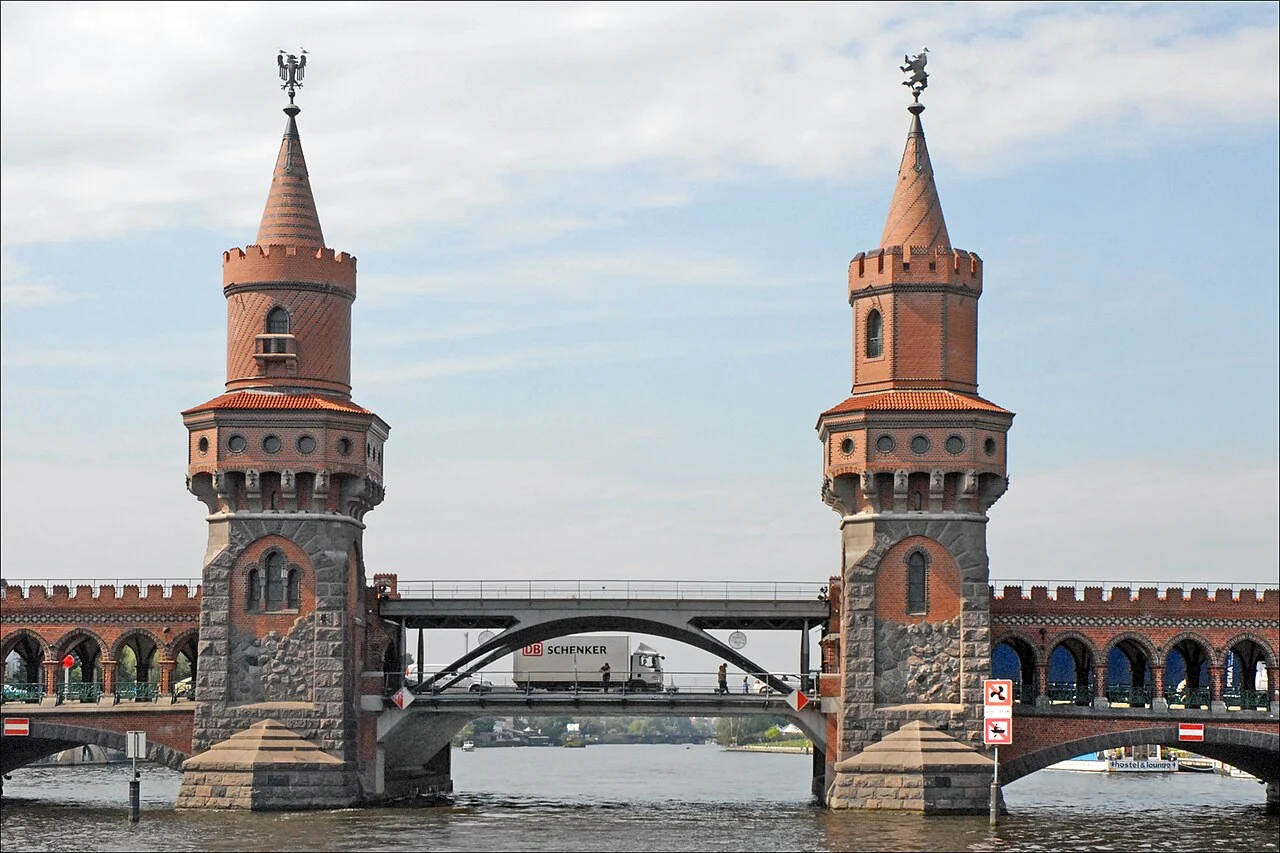
Migration needs a bridge to local participation
Adapted from Patricia Pfau’s Europe in Motion series. Sources reviewed on 7 October 2026. Statistical reference years and important limitations are stated; check original sources for later changes. Commentary, not individual legal advice.
On 1 January 2023, Eurostat’s current country-of-birth stock series counted 16.36 million foreign-born residents in Germany, about 19.7% of the population (16,362,854 of 83,118,501). This is a stock by country of birth, not a count of foreign citizens or people with an immigration history. In 2023, Destatis recorded 1,932,509 arrivals and 1,269,545 departures, a net migration of 662,964.
Germany’s Integration Course is the federal programme that combines German-language teaching with civic and orientation education. Its purpose is to help newcomers handle everyday life and participate in society.
How does the Integration Course work?
A general course has 700 45-minute lesson units: 600 for language and 100 for orientation. Special-target-group courses can total up to 1,000 units—up to 900 language units plus 100 orientation units. An intensive course is shorter at 500 units (400 language and 100 orientation) and is intended for people with good learning conditions.
The language component covers practical areas such as work, education, housing, health, forms and job applications. The course and examinations are in German. Special courses include literacy and low-literacy options. The orientation course covers Germany’s legal system, history and culture, rights and obligations, community life, tolerance, freedom of religion and equality between women and men.
Approved providers offer the classes locally with BAMF support. Participants take the German Test for Immigrants (DTZ) at the end of the language course and Life in Germany at the end of the orientation course. The general course’s language target is B1, not B2.
Is it mandatory?
Not for everyone. Entitlement and any obligation depend on residence status, language ability and personal circumstances. The Foreigners Authority can require newly arrived people who cannot communicate in German simply or sufficiently to attend; Jobcentres and other competent benefits authorities can also require or authorise participation in specified circumstances. Schooling, vocational training, employment and care responsibilities can affect whether an obligation is reasonable or applies. Others have an entitlement or attend voluntarily. The details can change with a person’s status, so current BAMF information—not this article—should be used for individual decisions.
Who pays and where are the classes?
BAMF funds the system through approved local providers. The current participant contribution is normally €2.29 per 45-minute unit, or €1,603 for 700 units. Some groups are automatically exempt; others can apply for an exemption because of benefits, low income or financial hardship. Income thresholds and administrative rules can change. A participant who completes the final examination successfully within the applicable period may, subject to the rules and an application, receive a 50% refund of the contribution.
Classes are offered locally. People can search through BAMF-NAvI or ask the Foreigners Authority and migration advice services.
Is there a place for everyone?
Not necessarily an immediately convenient place. Under the Integration Course Ordinance, a course should begin no later than six weeks after registration. If no course starts within that period, the provider must inform the participant and BAMF; BAMF should assign an obliged participant to another suitable provider and may refer an entitled participant elsewhere. This is a timeliness rule, not a guarantee of a convenient schedule. Local capacity, transport and childcare can still shape whether a course is workable.
In 2025, around 307,000 new participants began an integration course (307,030), and 18,920 teachers were active on 31 December. BAMF’s DTZ table for the same year records 259,701 test participants in the general integration course: 57.8% reached B1, 32.3% reached A2 and 9.9% were below A2. These are results for the DTZ test group—not for everyone who started a course—and the table’s test-participant totals include repeat test-takers.
A national standard helps, but access, childcare, transport and local capacity can shape whether integration becomes participation.
Integration is not a single course. It is a relationship between systems and people.
Footnote: B1 is an independent-user level at which a learner can handle familiar situations and connected everyday communication. B2 is a stronger independent-user level involving complex language and more fluent interaction. B2 is not the standard endpoint of the general Integration Course.
Sources
- Eurostat, EU population diversity by citizenship and country of birth (data extracted 2026; stock reference years include 2023 and 2025), with the migr_pop3ctb country-of-birth dataset and demo_pjan population dataset.
- Destatis, Migration between Germany and foreign countries, 1950 to 2025 (2023 flows; table current 2026).
- BAMF, Integrationskurse leaflet (stand April 2026).
- BAMF, Content and stages of the procedure (course structure and tests; current page accessed 2026).
- BAMF, Foreign nationals: participation and costs (13 August 2026).
- BAMF, What does an integration course cost and BAMF-NAvI (current 2026 service information).
- Integration Course Ordinance, §7 and §9 (current legal text accessed 2026).
- BAMF, Integration-course business statistics for 2025 (report dated 28 May 2026).
- Council of Europe, CEFR self-assessment grid (B1 and B2 descriptors).